
Just saw this watch in ebay and decided to share it. I guess most of the people here have seen similar examples, but maybe some haven't...
Discoloration of the acrylic glass of a hand watch after many years of exposure to the radium-containing paint on the dial and the hands.
Does anybody know what exactly happens with the polymethyl methacrylate in therms of chemistry?
Visual effect of long term radiation exposure on the acrylic glass of a watch
-
Svilen

- Posts: 190
- Joined: 23 Sep 2016, 04:25
Visual effect of long term radiation exposure on the acrylic glass of a watch
You do not have the required permissions to view the files attached to this post.
-
Geoff
- Posts: 141
- Joined: 01 May 2015, 12:21
Re: Visual effect of long term radiation exposure on the acrylic glass of a watch
I don't know enough about the chemistry of plastics to comment on what's happening in the watch glass, but I do know that radiation plays a large part in the color of gemstones/minerals. Ionization can alter color centers in minerals changing their color. this is often the case with smoky quartz and black fluorite. This damage can actually be reversed by annealing the crystal. you can see this in a series of photos I made of a specimen of chlorophane.
You do not have the required permissions to view the files attached to this post.
-
Sesselmann

- Posts: 1398
- Joined: 27 Apr 2015, 11:40
Re: Visual effect of long term radiation exposure on the acrylic glass of a watch
Svilen,
Thanks for sharing, a very interesting image..
I know that some personal dosimeters contain a strip of plastic, and when they analyse the strips under a microscope they count the tracks made in the plastic. Someone here might know more about this method than me.
Steven
Thanks for sharing, a very interesting image..
I know that some personal dosimeters contain a strip of plastic, and when they analyse the strips under a microscope they count the tracks made in the plastic. Someone here might know more about this method than me.
Steven
-
Svilen
- Posts: 190
- Joined: 23 Sep 2016, 04:25
Re: Visual effect of long term radiation exposure on the acrylic glass of a watch
Reading Geoff's post, reminded me that thoriated lenses of old photo objectives get yellowish in time and users found that exposing them to strong sunlight reverses the discoloration - annealing helps in this case too.
This picture and some more information and comparison before/after annealing can be found here.
The reason is the same as for the smoky quartz - F-centers (from "Farbezentrum" in German, which means color center) are induced due to ioniziation. This is a crystallographic defect, where an anionic vacancy in a crystal lattice is filled by unpaired electron/s, which absorb visible light and a normally transparent material becomes colored. Even when the glass is actually amorphous solid, the silica tetrahedron in its microstructure makes the F-centers formation possible. I read a bit more and it seems that this is the process, responsible for the discoloration of the acrylic too, as explained in the attached document: Additionally, the excitation and ionization of an organic molecule lead to several other possible effects - gas evolution, polymerization, crosslinking, degradation and double-bond formation, which all can lead to changes in the physical properties. Exposed to ionizing radiation, polymers often undergo chain scission - the molecules are being broken into smaller fragments, or crosslinking - larger molecules are formed, greatly affecting material properties. More about this can be found in the article attached here:
The reason is the same as for the smoky quartz - F-centers (from "Farbezentrum" in German, which means color center) are induced due to ioniziation. This is a crystallographic defect, where an anionic vacancy in a crystal lattice is filled by unpaired electron/s, which absorb visible light and a normally transparent material becomes colored. Even when the glass is actually amorphous solid, the silica tetrahedron in its microstructure makes the F-centers formation possible. I read a bit more and it seems that this is the process, responsible for the discoloration of the acrylic too, as explained in the attached document: Additionally, the excitation and ionization of an organic molecule lead to several other possible effects - gas evolution, polymerization, crosslinking, degradation and double-bond formation, which all can lead to changes in the physical properties. Exposed to ionizing radiation, polymers often undergo chain scission - the molecules are being broken into smaller fragments, or crosslinking - larger molecules are formed, greatly affecting material properties. More about this can be found in the article attached here:
You do not have the required permissions to view the files attached to this post.
-
Peter-1

- Posts: 170
- Joined: 07 Oct 2016, 01:45
Re: Visual effect of long term radiation exposure on the acrylic glass of a watch
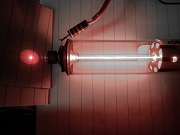
I can show two examples of my old glass tubes. An X-ray tube for thorax imaging and a large tube for use in computed tomography.
for power CT
Peter
You do not have the required permissions to view the files attached to this post.
-
Svilen
- Posts: 190
- Joined: 23 Sep 2016, 04:25
Re: Visual effect of long term radiation exposure on the acrylic glass of a watch
Nice collection Peter, these tubes are quite expensive even used or nonfunctional. From the stand I see that it is also well presented.
I've seen the old ones often darkened, but totally forgot about them in this topic, thanks for raising this point. In case you don't care much about the discoloration or have enough old tubes, you can try if UV light will decrease/remove it ;)
I've seen the old ones often darkened, but totally forgot about them in this topic, thanks for raising this point. In case you don't care much about the discoloration or have enough old tubes, you can try if UV light will decrease/remove it ;)
-
gwgw
- Posts: 57
- Joined: 13 May 2019, 08:09
Re: Visual effect of long term radiation exposure on the acrylic glass of a watch
I remember watching a video where they put acryllic plastic glass through an electron beam irradiation device. There was also a gopro camera inside, placed inside a lead shield that was pointed towards that glass. At the moment the carriage went under the beam, the camera got completely crazy, recording something that looks like analog TV static. That went for just a second or two. Miraculously, the camera survived. But right after that, that acryllic plastic looked very different. It wasn't discolored...but it had something like cracks in it. Well not sure if "cracks" is the correct word. Somewhere in the video comments, the author wrote that they deliberately put acryllic glass inside and that effect on it is desired. For some reason people pay good money for it.
Unfortunately I can't find that youtube video for some reason :(
Unfortunately I can't find that youtube video for some reason :(
-
Sesselmann
- Posts: 1398
- Joined: 27 Apr 2015, 11:40
Re: Visual effect of long term radiation exposure on the acrylic glass of a watch
I am pretty sure that was one of my friend Andrew Selzmann's videos.
https://www.youtube.com/channel/UCZXBeb ... Z7g/videos
Steven
