High voltage
Posted: 03 Nov 2017, 01:35
Like I said in my introduction to this board, I'm planning to build a Farnsworth-Hirsch-Meeks fusor. In case you don't know what that is, it's an inertial electrostatic confinement nuclear fusion device. More info on that at fusor.net and its associated discussion boards.
Having recently completed and tested my neutron detection device, which will be used to confirm nuclear fusion once I achieve it, I am now concentrating on the next subsystem that I need, which is the high voltage, high power source.
Fusion doesn't require only high voltage, it also requires enough power at the high voltage. At a minimum one should supply 20kV at 20mA to obtain detectable fusion (rough minimum estimate). That's 400W of power.
I will aim higher. As a first goal, I will target 30kV (or more) at 30mA (or more). That's 900W of power.
I was unsuccessful in finding an affordable power supply with the required parameters. While I am still looking, I've decided to make my own power supply. For efficiency, it will be a switched mode power supply (SMPS) with a ferrite core transformer.
All calculations below are for a frequency of the SMPS of 20kHz.
A quick back-of-the-napkin calculation gives me this for the requirements of the ferrite transformer. For a supported power of 900W, it would need a core area of at least 35cm^2. The power supported increases with the square of the core area.
Cores that I can find at reasonable prices online are EE140 type, which have a core area of 4x4=16cm^2. One of these supports about 180W power transfer. Not enough. But if I stick 2 of them together in parallel that will give me a core area of 32cm^2, or a power of about 750W. Still not enough. How about 3 cores? That is an area of 48cm^2, and power of about 1700W. Check.
The material of these cores is a Mn-Zn ferrite, PC40. Datasheet gives for PC40:
-initial permeability 2300 at 23 degrees C
-Curie temperature above 200 degrees C
-saturation flux Bs of 0.5T at 23 degrees, or 0.38T at 100 degrees C; this is important.
I will assume that it will be pushed to its limits and calculate for max temperature of 100C.
From previous failures I have acquired the habit of over-engineering things. This not only gives me a safety factor, but also allows me to upgrade stuff in place if I need higher specs later.
So I will multiply the Bs at 100C with a factor of 0.3 and use that for calculations as maximum flux.
That gives me a Bs of 0.38 * 0.3=0.114T, or 114mT or 1140gauss.
Calculations for primary winding.
B(gauss)=V*T(on)*10^8/2*Ae*N
V=primary voltage
T(on)=duty cycle/frequency
Ae=core area (cm^2)
N=number of turns
Or expressed otherwise
N/V (turns per volt)=T(on)*10^8/2*Ae*B
T(on)=0.5(square wave with 50% duty cycle)/20000Hz=0.25*10^-4
Ae=48cm^2
B=1140gauss
thus N/V=0.25*10^4/2*48*1140=0.25/10.944=0.0228 turns per volt
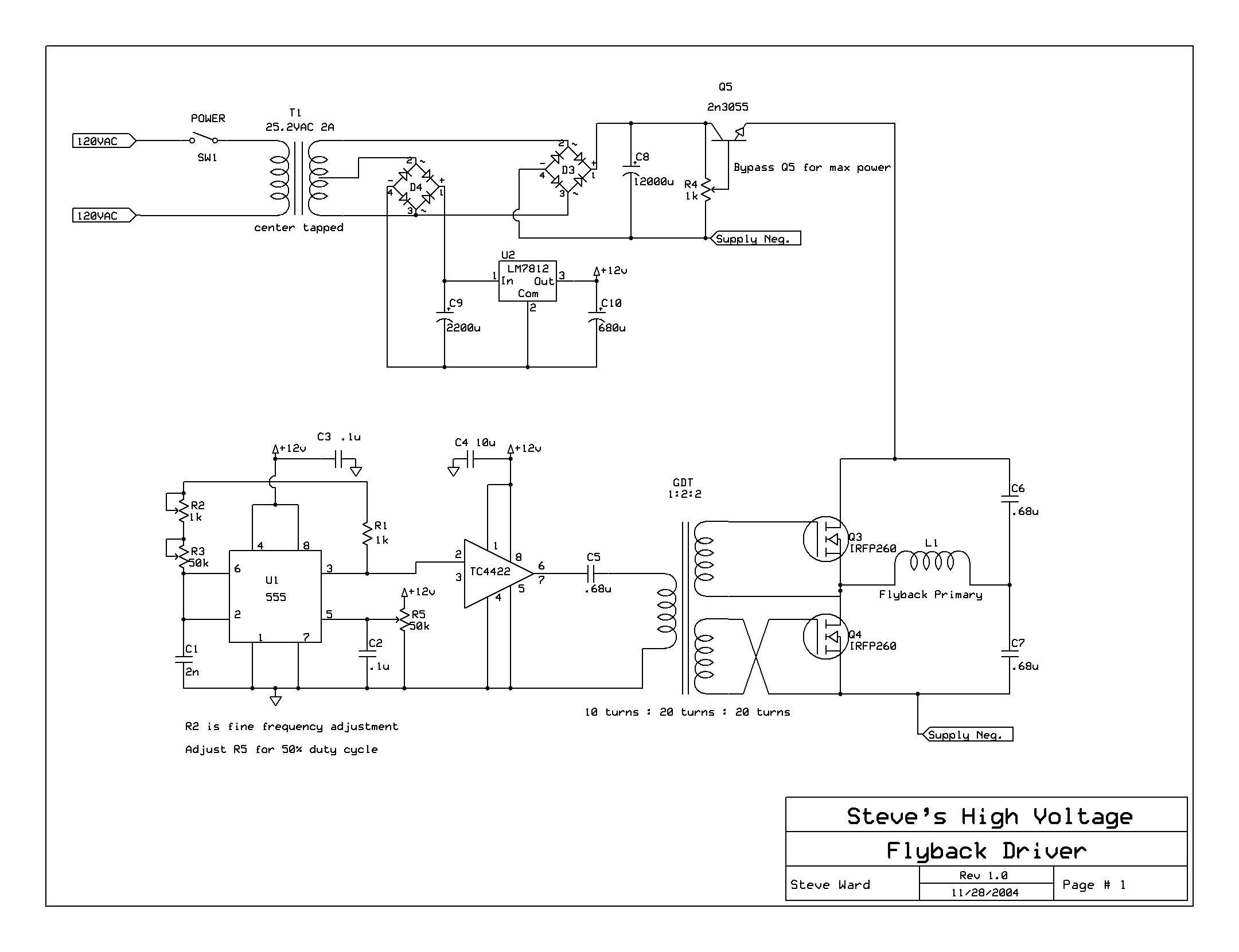
For the primary I will use mains AC (120V in the US), passed through a 2KW autotransformer for power control, rectified with a full-wave bridge and filtered, then switched on/off at 20kHz/50% duty cycle with power mosfets (probably a half-bridge configuration) into the primary.
120V is the Vrms of the mains; Vpeak is 169V (Vrms/0.707); Vaverage is 108V
I will aim for an average voltage of 12000V in the secondary, thus use the 108V value in the subsequent power calculations. The Vpeak in the secondary will be 18837V, and I will use this to select components. I won't calculate a transformer that gives me more than this for practical reasons (insulation etc), and will raise the voltage to the desired values using a Cockroft-Walton voltage multipler in the secondary.
I will derive the current needed in the secondary from what the CW multiplier needs to achieve the desired output parameters.
For an input of 12000V, a 1-stage CW multiplier using 4nF capacitors at a frequency of 20kHz, in order to supply 30mA output will require at least 83mA input current. The output voltage will be 33kV with a ripple of 380V. That is acceptable.
Will round up required current to 100mA. This is what I will use in subsequent secondary calculations.
Primary turns.
N/V=0.0228 (from above) V=108V (average), 168V(peak)
N=2.46 turns for average voltage, or 3.69 for peak. Round up to 4 turns.
Secondary turns.
Vavg=12000V, Vpeak=18837V. Turn ratio=12000/108 + 10% (compensate for losses)=111.11+11.11=122.22. Round up to 123
Turns=123*4=492.
The wire needs to carry 100mA at least, so a minimum of 31AWG, or 0.226mm diameter. That will take a current of up to 113mA. Check.
If I later would require the secondary to provide moire current I could use 30AWG (up to 140mA) or AWG29 (up to 180mA). It would be pointless to increase the wire gauge above that, since at 180mA the power would be 2100W, which is more than the transformer core supports. AWG30 would support up to 1680W which is within core spec. Make a note to not exceed 140mA in the secondary.
Primary wire.
Current in primary: 100mA*123(turn ratio)=12.3A Will apply the same overengineering concept and round up to 15A minimum.
Wire size for 15A is 10AWG, or 2.58mm diameter. But hold, at 20kHz there will be a skin effect. The skin depth at 20kHz is 0.5mm, so any wire over 1mm diameter will be affected by a reduction in its current carrying capacity. For 10AWG, this leaves a surface area equivalent of 21AWG (0.72mm diameter) which can only carry 1.2A. Not good enough.
Quick area calculations taking into effect the skin effect shows that I will need primary wire of at least 6.89mm diameter. 1AWG(7.34mm diameter) is the choice. Check.
So overall I will need:
3*EE140 cores in parallel
4 turns of 1AWG wire primary wound over all 3 cores at once
492 turns of 31AWG wire wound over all 3 cores at once. (113mA max). Or 30AWG (140mA max)
Cross-sectional area of secondary winding: for 30AWG, d=0.254mm; add 50% allowance for insulation, 0.381mm diameter. Area of each wire 0.114mm^2. Times 492 gives 56mm^2. Adjusting for a fill ratio of 1/3, total secondary cross-section 168.2mm^2 or 1.68cm^2. That will fit in the core window without any problem. Can even consider using 29AWG from the start for extra tolerance and reduced DC losses (lower secondary DC resistance).
End transformer calculations.
Input: AC mains through autotransformer, full wave rectifier bridge, filtering capacitor (all specified for at least 200V, 15A); half-bridge MOSFET plus driver at 20kHz.
Output: 1-stage CW multiplier, 33kV at 30mA.
Power required for output including CW losses: 996W, approx 1kW.
Can later add a second CW stage for higher output. With the second stage, output would be 64kV/30mA with 2600V ripple, but the secondary current would rise to 161mA and total power required rise to 1937W. That is out of spec.
However if I only require a current of 18mA the output will be 65kV with 1600V ripple, and secondary current 98mA for power of 1200W. That is within spec. So this upgrade in place would be viable without needing the transformer to be rewound. More voltage and more power=better fusion efficiency.
The maximum I could extract from this design with 2-stage CW multiplier, based on the 140mA limit for the secondary current set above, would be 26mA at 65kV with 2200V ripple. That gives a power of 1688W.
Decreasing the ripple would require increasing the value of the capacitors. For instance, using the values in the max above, increasing the cap value to 8nF (2 in parallel) decreases the ripple to 1140V, and 12nF (3 each in parallel) to 758V. It would be a worthwhile upgrade, but these high-voltage caps are expensive.
The weight of the transformer, based on the weight of the cores plus that of the wire, is estimated at about 12kg. Size 14x14x12cm.
Please feel free to check my calculations and make appropriate corrections.
Having recently completed and tested my neutron detection device, which will be used to confirm nuclear fusion once I achieve it, I am now concentrating on the next subsystem that I need, which is the high voltage, high power source.
Fusion doesn't require only high voltage, it also requires enough power at the high voltage. At a minimum one should supply 20kV at 20mA to obtain detectable fusion (rough minimum estimate). That's 400W of power.
I will aim higher. As a first goal, I will target 30kV (or more) at 30mA (or more). That's 900W of power.
I was unsuccessful in finding an affordable power supply with the required parameters. While I am still looking, I've decided to make my own power supply. For efficiency, it will be a switched mode power supply (SMPS) with a ferrite core transformer.
All calculations below are for a frequency of the SMPS of 20kHz.
A quick back-of-the-napkin calculation gives me this for the requirements of the ferrite transformer. For a supported power of 900W, it would need a core area of at least 35cm^2. The power supported increases with the square of the core area.
Cores that I can find at reasonable prices online are EE140 type, which have a core area of 4x4=16cm^2. One of these supports about 180W power transfer. Not enough. But if I stick 2 of them together in parallel that will give me a core area of 32cm^2, or a power of about 750W. Still not enough. How about 3 cores? That is an area of 48cm^2, and power of about 1700W. Check.
The material of these cores is a Mn-Zn ferrite, PC40. Datasheet gives for PC40:
-initial permeability 2300 at 23 degrees C
-Curie temperature above 200 degrees C
-saturation flux Bs of 0.5T at 23 degrees, or 0.38T at 100 degrees C; this is important.
I will assume that it will be pushed to its limits and calculate for max temperature of 100C.
From previous failures I have acquired the habit of over-engineering things. This not only gives me a safety factor, but also allows me to upgrade stuff in place if I need higher specs later.
So I will multiply the Bs at 100C with a factor of 0.3 and use that for calculations as maximum flux.
That gives me a Bs of 0.38 * 0.3=0.114T, or 114mT or 1140gauss.
Calculations for primary winding.
B(gauss)=V*T(on)*10^8/2*Ae*N
V=primary voltage
T(on)=duty cycle/frequency
Ae=core area (cm^2)
N=number of turns
Or expressed otherwise
N/V (turns per volt)=T(on)*10^8/2*Ae*B
T(on)=0.5(square wave with 50% duty cycle)/20000Hz=0.25*10^-4
Ae=48cm^2
B=1140gauss
thus N/V=0.25*10^4/2*48*1140=0.25/10.944=0.0228 turns per volt
For the primary I will use mains AC (120V in the US), passed through a 2KW autotransformer for power control, rectified with a full-wave bridge and filtered, then switched on/off at 20kHz/50% duty cycle with power mosfets (probably a half-bridge configuration) into the primary.
120V is the Vrms of the mains; Vpeak is 169V (Vrms/0.707); Vaverage is 108V
I will aim for an average voltage of 12000V in the secondary, thus use the 108V value in the subsequent power calculations. The Vpeak in the secondary will be 18837V, and I will use this to select components. I won't calculate a transformer that gives me more than this for practical reasons (insulation etc), and will raise the voltage to the desired values using a Cockroft-Walton voltage multipler in the secondary.
I will derive the current needed in the secondary from what the CW multiplier needs to achieve the desired output parameters.
For an input of 12000V, a 1-stage CW multiplier using 4nF capacitors at a frequency of 20kHz, in order to supply 30mA output will require at least 83mA input current. The output voltage will be 33kV with a ripple of 380V. That is acceptable.
Will round up required current to 100mA. This is what I will use in subsequent secondary calculations.
Primary turns.
N/V=0.0228 (from above) V=108V (average), 168V(peak)
N=2.46 turns for average voltage, or 3.69 for peak. Round up to 4 turns.
Secondary turns.
Vavg=12000V, Vpeak=18837V. Turn ratio=12000/108 + 10% (compensate for losses)=111.11+11.11=122.22. Round up to 123
Turns=123*4=492.
The wire needs to carry 100mA at least, so a minimum of 31AWG, or 0.226mm diameter. That will take a current of up to 113mA. Check.
If I later would require the secondary to provide moire current I could use 30AWG (up to 140mA) or AWG29 (up to 180mA). It would be pointless to increase the wire gauge above that, since at 180mA the power would be 2100W, which is more than the transformer core supports. AWG30 would support up to 1680W which is within core spec. Make a note to not exceed 140mA in the secondary.
Primary wire.
Current in primary: 100mA*123(turn ratio)=12.3A Will apply the same overengineering concept and round up to 15A minimum.
Wire size for 15A is 10AWG, or 2.58mm diameter. But hold, at 20kHz there will be a skin effect. The skin depth at 20kHz is 0.5mm, so any wire over 1mm diameter will be affected by a reduction in its current carrying capacity. For 10AWG, this leaves a surface area equivalent of 21AWG (0.72mm diameter) which can only carry 1.2A. Not good enough.
Quick area calculations taking into effect the skin effect shows that I will need primary wire of at least 6.89mm diameter. 1AWG(7.34mm diameter) is the choice. Check.
So overall I will need:
3*EE140 cores in parallel
4 turns of 1AWG wire primary wound over all 3 cores at once
492 turns of 31AWG wire wound over all 3 cores at once. (113mA max). Or 30AWG (140mA max)
Cross-sectional area of secondary winding: for 30AWG, d=0.254mm; add 50% allowance for insulation, 0.381mm diameter. Area of each wire 0.114mm^2. Times 492 gives 56mm^2. Adjusting for a fill ratio of 1/3, total secondary cross-section 168.2mm^2 or 1.68cm^2. That will fit in the core window without any problem. Can even consider using 29AWG from the start for extra tolerance and reduced DC losses (lower secondary DC resistance).
End transformer calculations.
Input: AC mains through autotransformer, full wave rectifier bridge, filtering capacitor (all specified for at least 200V, 15A); half-bridge MOSFET plus driver at 20kHz.
Output: 1-stage CW multiplier, 33kV at 30mA.
Power required for output including CW losses: 996W, approx 1kW.
Can later add a second CW stage for higher output. With the second stage, output would be 64kV/30mA with 2600V ripple, but the secondary current would rise to 161mA and total power required rise to 1937W. That is out of spec.
However if I only require a current of 18mA the output will be 65kV with 1600V ripple, and secondary current 98mA for power of 1200W. That is within spec. So this upgrade in place would be viable without needing the transformer to be rewound. More voltage and more power=better fusion efficiency.
The maximum I could extract from this design with 2-stage CW multiplier, based on the 140mA limit for the secondary current set above, would be 26mA at 65kV with 2200V ripple. That gives a power of 1688W.
Decreasing the ripple would require increasing the value of the capacitors. For instance, using the values in the max above, increasing the cap value to 8nF (2 in parallel) decreases the ripple to 1140V, and 12nF (3 each in parallel) to 758V. It would be a worthwhile upgrade, but these high-voltage caps are expensive.
The weight of the transformer, based on the weight of the cores plus that of the wire, is estimated at about 12kg. Size 14x14x12cm.
Please feel free to check my calculations and make appropriate corrections.