Svilen,
I can't think of anything that would give you a single 930 keV peak, so you might need to look outside the box, maybe try another detector.
Steven
CS-137 Spectrum, new shield
-
Sesselmann

- Posts: 1383
- Joined: 27 Apr 2015, 11:40
- Location: Sydney
- Contact:
Re: CS-137 Spectrum, new shield
Steven Sesselmann | Sydney | Australia | https://gammaspectacular.com | https://beejewel.com.au | https://www.researchgate.net/profile/Steven-Sesselmann

Re: CS-137 Spectrum, new shield
Yes, maybe that's the next thing to try...just I don't have another detector at the moment. But it seems the shield is OK at least, do you agree?
Svilen
Re: CS-137 Spectrum, new shield
IMHO that peak is the 40K in non linear highly compressed spectrum, and the 6.1% resolution is due to this compressed spectra....... probably the real resolution should be around 8.5-9% for that type of detector.
You should not use the 32keV 133Ba X-ray as peak for calibration because NaI(Tl) are nowhere linear below 100keV.
You should not use the 32keV 133Ba X-ray as peak for calibration because NaI(Tl) are nowhere linear below 100keV.
Ciro
Re: CS-137 Spectrum, new shield
Hi,
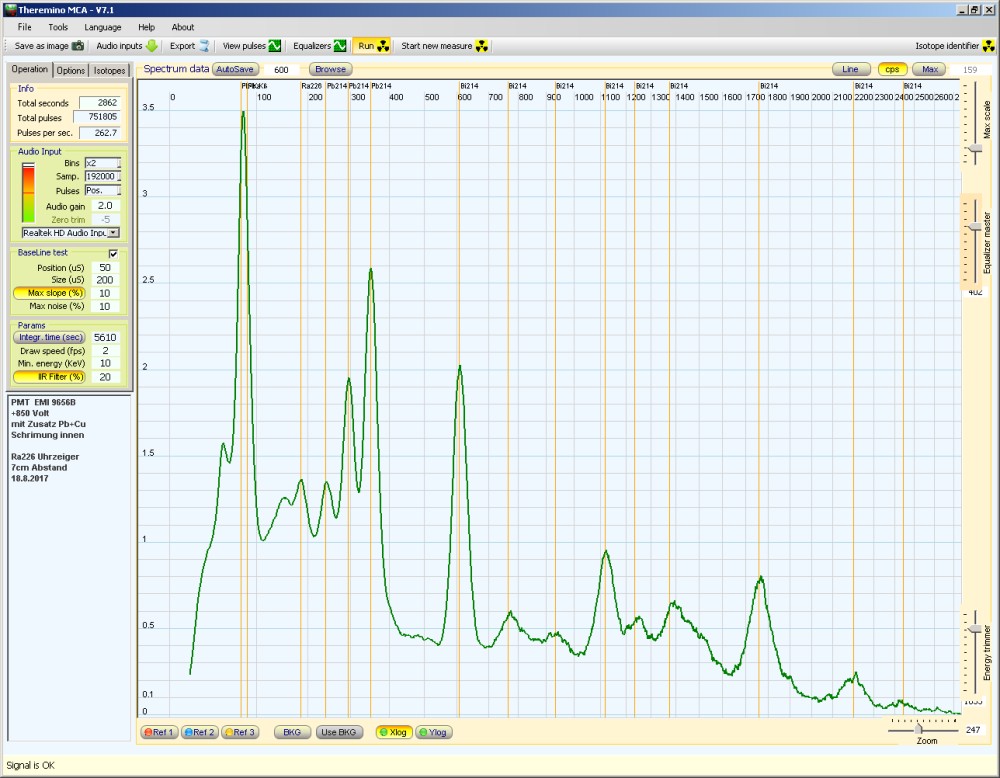
I think it will be best if you take an old clock with luminescent hands. There are very many lines to control the system.
http://fs1.directupload.net/images/171214/c4g69shz.jpg
Peter
I think it will be best if you take an old clock with luminescent hands. There are very many lines to control the system.
http://fs1.directupload.net/images/171214/c4g69shz.jpg
Peter
Re: CS-137 Spectrum, new shield
Thanks for all the helpful comments!
Seems it really is a compressed spectrum and this peak is from a higher energy. I lowered the HV today with 100V and run now the detector on 1KV insted of 1.1KV, which gave maybe more realistic results which you can see below. I don't know the optimal voltage for this detector (Thermo Fischer Scientific SPA-3) and the only source of information I found, was telling that the maximal voltage is 1600V, so I thought better use something like 1100V than lower. Additionally, I tried to estimate the optimal voltage increasing it gradualy and looking for the change in count number and it didn't really reach a plateau till 1100V, so I used it. But lowering the HV with 100V brought the following change in the spectra (not so compressed anymore). Now the mysterious peak look closer to the K40 energy and maybe good calibration will bring it there. I also have radium watch, the cesium tube, a lutetium crystal, a thorium mantle and uranium glass - will use them to calibrate better. Unfortunately they all are more useful for the lower range, not the energies above 1000KeV, but still useful I hope. I also ordered today 100g of pure potassium iodide, but now I worry it could be too less to get a good activity?
Here is what I got lowering the detector supply voltage from 1100V to 1000V:
Cs-tube
https://imgur.com/a/QkRWh
background without shielding:
https://imgur.com/a/bqf3E
Do you think the HV was really the problem? If now the peak from potassium iodide match the one I got there, I guess the mystery is solved, but if not... I definitely have to play more with different options, sound cards...
Seems it really is a compressed spectrum and this peak is from a higher energy. I lowered the HV today with 100V and run now the detector on 1KV insted of 1.1KV, which gave maybe more realistic results which you can see below. I don't know the optimal voltage for this detector (Thermo Fischer Scientific SPA-3) and the only source of information I found, was telling that the maximal voltage is 1600V, so I thought better use something like 1100V than lower. Additionally, I tried to estimate the optimal voltage increasing it gradualy and looking for the change in count number and it didn't really reach a plateau till 1100V, so I used it. But lowering the HV with 100V brought the following change in the spectra (not so compressed anymore). Now the mysterious peak look closer to the K40 energy and maybe good calibration will bring it there. I also have radium watch, the cesium tube, a lutetium crystal, a thorium mantle and uranium glass - will use them to calibrate better. Unfortunately they all are more useful for the lower range, not the energies above 1000KeV, but still useful I hope. I also ordered today 100g of pure potassium iodide, but now I worry it could be too less to get a good activity?
Here is what I got lowering the detector supply voltage from 1100V to 1000V:
Cs-tube
https://imgur.com/a/QkRWh
background without shielding:
https://imgur.com/a/bqf3E
Do you think the HV was really the problem? If now the peak from potassium iodide match the one I got there, I guess the mystery is solved, but if not... I definitely have to play more with different options, sound cards...
Svilen
Re: CS-137 Spectrum, new shield
I tend to run detectors at the lowest (or close) voltage where they will work reliably. It not only cuts down wear and tear on the photomultiplier, but also I tend to see the best results at these lower voltages. And in fact this also applies to other types of detectors in my experience (Geiger tubes, neutron detectors etc)
All of my PMT-based detectors (most of which I built myself) are running smoothly at 700V or close to that. The tubes I'm using for them are: Hamamatsu R10133, R6095, R9420 and Photonis XP5312. The rule of thumb holds true for all of them.
All of my PMT-based detectors (most of which I built myself) are running smoothly at 700V or close to that. The tubes I'm using for them are: Hamamatsu R10133, R6095, R9420 and Photonis XP5312. The rule of thumb holds true for all of them.
Real name: Silviu Tamasdan
Re: CS-137 Spectrum, new shield
Yes , now it looks fine, and definitly that is the K40 peak.Svilen wrote:Thanks for all the helpful comments!
Do you think the HV was really the problem? I.
Ciro
Re: CS-137 Spectrum, new shield
Yeah, the resolution is also a more realistic one of around 8%. I thought the lower voltage could extend PMT life and also wanted to go for it, but in 1100V it looked that I got more and stronger pulses so I used it. I definitely have to try a good external sound card also..maybe I'd get an used sound blaster from e-bay. One other question - the amplitude of the pulses with volume to the maximum varies around 50-70 au (or % maybe we can say also) using InTune to check. How is that?
Svilen
-
Sesselmann
- Posts: 1383
- Joined: 27 Apr 2015, 11:40
- Location: Sydney
- Contact:
Re: CS-137 Spectrum, new shield
Svilen,
Unless you are secretly posting from a place without organic matter, it concerns me that there is no K40 in your spectra, this is usually a peak we can't get rid of.
Just a thought, but could there be a tiny arc in a connector somewhere, capacitance can cause a regular discharge resulting in a false peak. I have seen this in some poor quality coaxial cables with foam cores.
Unless you are secretly posting from a place without organic matter, it concerns me that there is no K40 in your spectra, this is usually a peak we can't get rid of.
Just a thought, but could there be a tiny arc in a connector somewhere, capacitance can cause a regular discharge resulting in a false peak. I have seen this in some poor quality coaxial cables with foam cores.
Steven Sesselmann | Sydney | Australia | https://gammaspectacular.com | https://beejewel.com.au | https://www.researchgate.net/profile/Steven-Sesselmann
Re: CS-137 Spectrum, new shield
For good or bad I also do post from a place with organic matter :) Just hope this peak, that after the HV adjustment is now closer to 1400KeV, will fit the K40 energy after calibration and a check with KI.
Svilen
Who is online
Users browsing this forum: No registered users and 40 guests