
Tommaso,
Just noticed your post..., yes that's all you need. A short cable with stereo jack at each end, but the left and right channels need to be crossed.
Important to understand that only one of the GS will connect to the PC, the other one will operate as a high voltage supply and analogue output only, so to avoid confusion it is a good idea to connect the primary GS to the PC before running PRA, once PRA is running you can connect the second unit.
In audio setting you need to select "Left and Right channel", 16 Bit, 384 kHz.
If your objective is only to observe muons you probably need to turn the gain right down low, and I suggest turning off the pulse shape method.
Good luck and please share your experiment 👍
Steven
Secondary Cosmic Rays
-
Sesselmann

- Posts: 1374
- Joined: 27 Apr 2015, 11:40
- Location: Sydney
- Contact:
Re: Secondary Cosmic Rays
Steven Sesselmann | Sydney | Australia | https://gammaspectacular.com | https://beejewel.com.au | https://www.researchgate.net/profile/Steven-Sesselmann

Re: Secondary Cosmic Rays
Hi, all,
I am sick with a cold for the first time in my life since I was in 7th grade and I'm now a month away from age 70! Of course, I'm 28 years into a kidney transplant so that's probably why! I just don't get sick so now that I am I am just reading old posts on this forum and Fusor.net. I don't have a fusor but am interested in Neutrons so that's the place to go.
I am also interested in Cosmic Rays and have tried some stuff. I am a programmer and not a diligent adherent to the scientific method. I am just interested in trying things and thinking about them.
I bought two of the CosmicWatch devices from a place in England already assembled. I am a horrible craftsman and while all my projects are beautifully executed masterpieces inside my head, in reality they turn out to be butcher jobs. I have not a craftsman's bone in my body. At my age, I now know this and try to buy assembled...
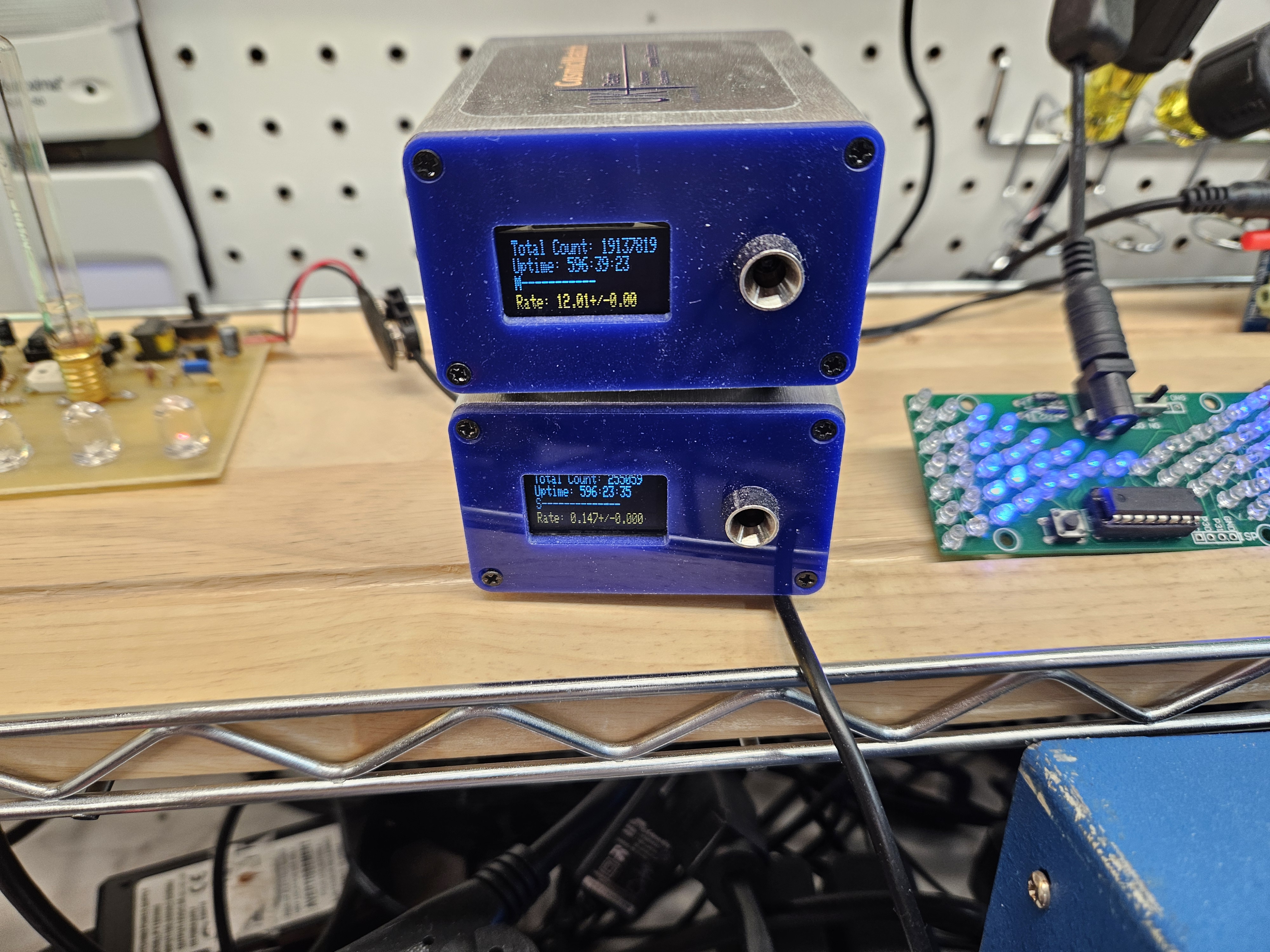
Anyway, I hooked the two CosmicWatch devices together in my basement lab and get about one coincidence every 20 seconds. They are not very adjustable or adaptable and seem to be not very sophisticated. I had a set sent to my buddy in Houston, Texas and he get about the same rate at sea level. I think I am at about 300 feet above sea level right next door to Washington, DC in Northern Virginia.
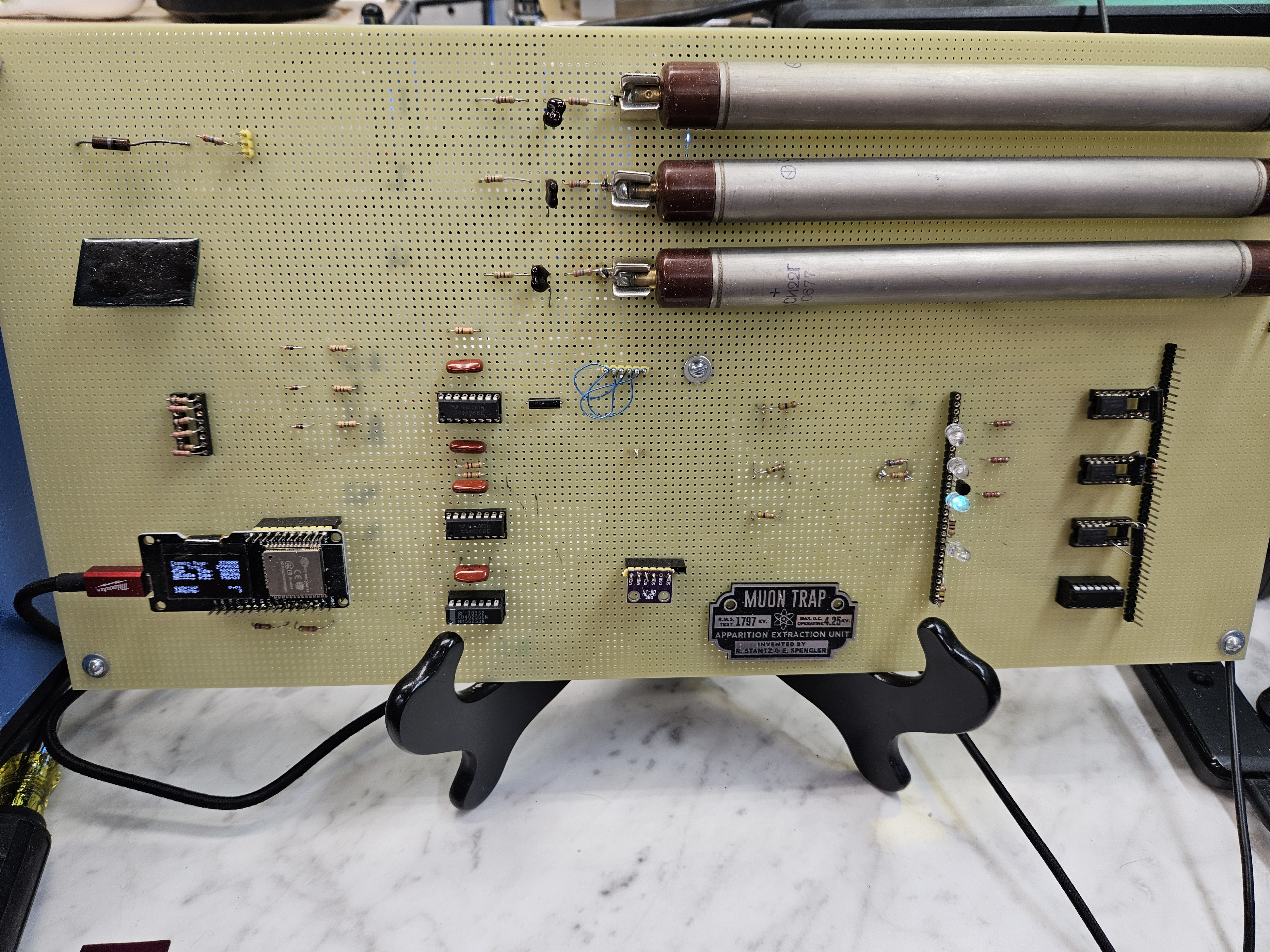
I also read Marek Dolleiser's paper, and understood it except for the complicated math part, and made my own three tube Muon Telescope, copying his circuit for the monostable vibrator timers. I used a timeout similar to his 80 usec and a hardware AND gate to do coincidences, not SW. I also did not use his base two weighting resistor scheme for telling which tubes were firing. I used an ESP32 and a 400 volt power supply that I like from a guy in Lithuania. I used a gigohm voltage divider and one of the ESP32's ADC input pins to read the high voltage. I keep some counts of each tube's detections and the coincidence totals via interrupts and display them on an OLED display and I have it visible on the web as a web page here:
http://miked99.ddns.net:1665/
Please just look at the numbers and don't try to log in. I am not sure it's a fool proof login algorithm and I just want to show you guys my efforts so far. It's the actual ESP32 hosting and updating the web page. It's live in my lab.
I found this three tube arrangement also gets about 1 coincidence (all three at once) every 20 seconds. I made this myself and had a really hard time with the electronics (after all, I am fundamentally a microprocessor programmer) and did not feel like I did a good job. I am functionally competent at wire-wrapping but it always pays to value function over form with my efforts!
(The MUON plastic label is something from eBay from the Ghost Busters movie. I am a boy at heart.)
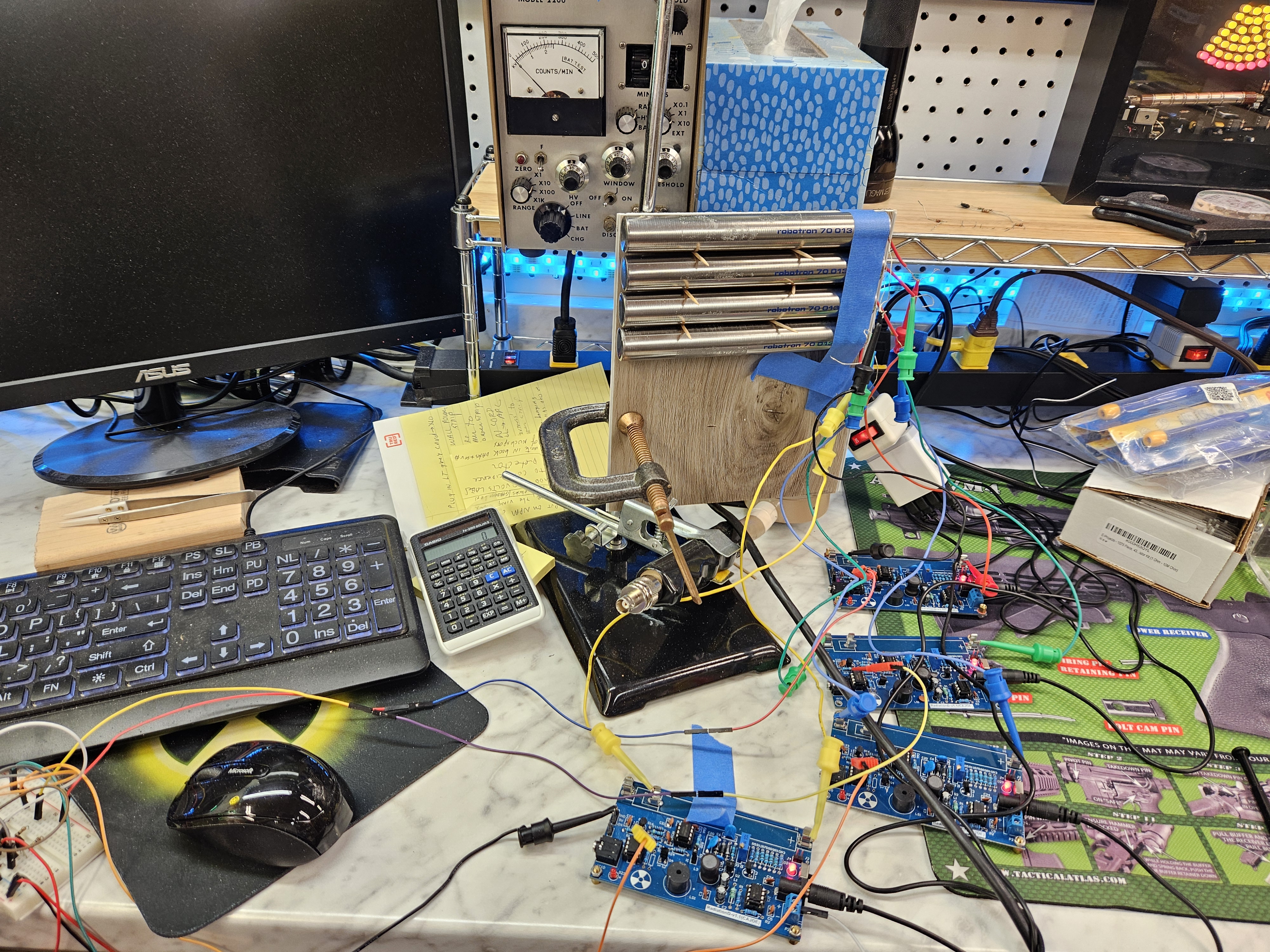
This last one is a prototype of a four-banger gamma tube Muon coincidence detector that I got an idea for. It uses four of these boards:
[broken link removed - Steven]
When I bought them they were $11.99 USD each including postage. For tubes I used four of these:
[broken link removed - Steven]
When I bought them they were $15.00 USD each plus shipping from Ukraine.
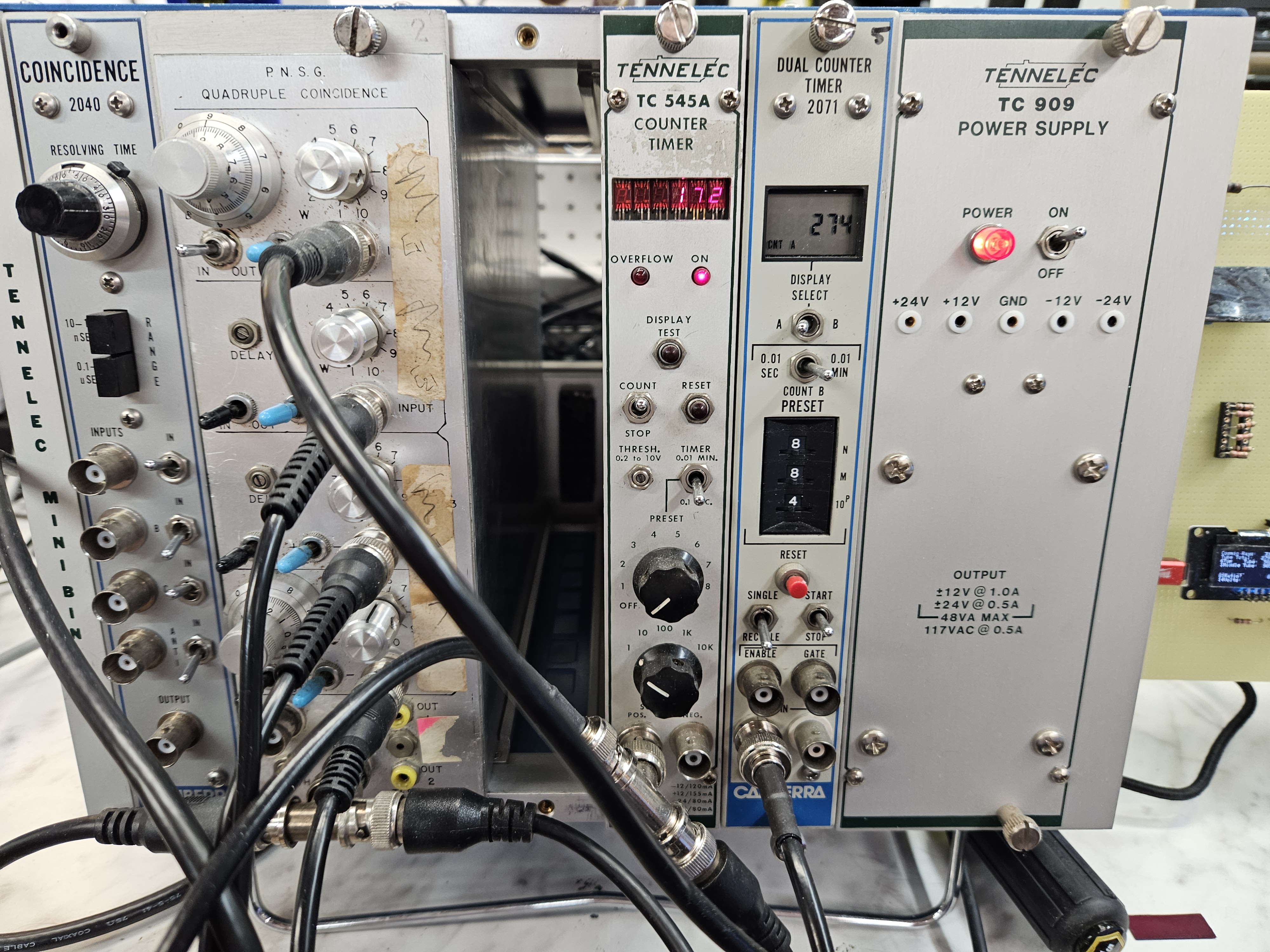
I hooked them all together with micro-hook jumper wires and made an NPN transistor TTL-to-10Volt-NIM logic level translator for each one on a proto bread board with "Dupont" jumpers and 22 ga phone wire and connected it to a NIM board that I got from eBay that does 4 input coincidences:
[broken link removed - Steven]
I can't find any documentation for this NIM board anywhere. I contacted ORTEC and they told me that they didn't make it. But it works! I get a positive 4-way coincidence once every 15 minutes or so. It just displays on my DSO oscilloscope.
The set up is rather ugly and temporary and I just was trying out an idea and I am not very organized, just very interested. This one is all out of my own head with enough wood left over to make another one, as my late father used to joke:
So, I think I am detecting Cosmic Ray Muons but not in a very sophisticated way. I couldn't have done any of it without the Internet and help from my electronical-genius friend Kevin in Texas.
What do you think?
Mike Driscoll
I am sick with a cold for the first time in my life since I was in 7th grade and I'm now a month away from age 70! Of course, I'm 28 years into a kidney transplant so that's probably why! I just don't get sick so now that I am I am just reading old posts on this forum and Fusor.net. I don't have a fusor but am interested in Neutrons so that's the place to go.
I am also interested in Cosmic Rays and have tried some stuff. I am a programmer and not a diligent adherent to the scientific method. I am just interested in trying things and thinking about them.
I bought two of the CosmicWatch devices from a place in England already assembled. I am a horrible craftsman and while all my projects are beautifully executed masterpieces inside my head, in reality they turn out to be butcher jobs. I have not a craftsman's bone in my body. At my age, I now know this and try to buy assembled...
Anyway, I hooked the two CosmicWatch devices together in my basement lab and get about one coincidence every 20 seconds. They are not very adjustable or adaptable and seem to be not very sophisticated. I had a set sent to my buddy in Houston, Texas and he get about the same rate at sea level. I think I am at about 300 feet above sea level right next door to Washington, DC in Northern Virginia.
I also read Marek Dolleiser's paper, and understood it except for the complicated math part, and made my own three tube Muon Telescope, copying his circuit for the monostable vibrator timers. I used a timeout similar to his 80 usec and a hardware AND gate to do coincidences, not SW. I also did not use his base two weighting resistor scheme for telling which tubes were firing. I used an ESP32 and a 400 volt power supply that I like from a guy in Lithuania. I used a gigohm voltage divider and one of the ESP32's ADC input pins to read the high voltage. I keep some counts of each tube's detections and the coincidence totals via interrupts and display them on an OLED display and I have it visible on the web as a web page here:
http://miked99.ddns.net:1665/
Please just look at the numbers and don't try to log in. I am not sure it's a fool proof login algorithm and I just want to show you guys my efforts so far. It's the actual ESP32 hosting and updating the web page. It's live in my lab.
I found this three tube arrangement also gets about 1 coincidence (all three at once) every 20 seconds. I made this myself and had a really hard time with the electronics (after all, I am fundamentally a microprocessor programmer) and did not feel like I did a good job. I am functionally competent at wire-wrapping but it always pays to value function over form with my efforts!
(The MUON plastic label is something from eBay from the Ghost Busters movie. I am a boy at heart.)
This last one is a prototype of a four-banger gamma tube Muon coincidence detector that I got an idea for. It uses four of these boards:
[broken link removed - Steven]
When I bought them they were $11.99 USD each including postage. For tubes I used four of these:
[broken link removed - Steven]
When I bought them they were $15.00 USD each plus shipping from Ukraine.
I hooked them all together with micro-hook jumper wires and made an NPN transistor TTL-to-10Volt-NIM logic level translator for each one on a proto bread board with "Dupont" jumpers and 22 ga phone wire and connected it to a NIM board that I got from eBay that does 4 input coincidences:
[broken link removed - Steven]
I can't find any documentation for this NIM board anywhere. I contacted ORTEC and they told me that they didn't make it. But it works! I get a positive 4-way coincidence once every 15 minutes or so. It just displays on my DSO oscilloscope.
The set up is rather ugly and temporary and I just was trying out an idea and I am not very organized, just very interested. This one is all out of my own head with enough wood left over to make another one, as my late father used to joke:
So, I think I am detecting Cosmic Ray Muons but not in a very sophisticated way. I couldn't have done any of it without the Internet and help from my electronical-genius friend Kevin in Texas.
What do you think?
Mike Driscoll
Mike Driscoll
Leesburg, Virginia
USA
Leesburg, Virginia
USA
-
Sesselmann
- Posts: 1374
- Joined: 27 Apr 2015, 11:40
- Location: Sydney
- Contact:
Re: Secondary Cosmic Rays
Mike,
Interesting project and web page, although I am not sure what I am seeing on the web page.
Steven
Interesting project and web page, although I am not sure what I am seeing on the web page.
Steven
Steven Sesselmann | Sydney | Australia | https://gammaspectacular.com | https://beejewel.com.au | https://www.researchgate.net/profile/Steven-Sesselmann
Who is online
Users browsing this forum: No registered users and 4 guests
