Apatite
Apatite
Hello,
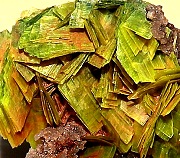
last weekend I visited a mineral fair and as always I had my dosimeter with me. I discovered the usuals suspects (green and yellow stuff) with or without a "radioactive" label.
But then I found a box containing about 50kg of blue rocks that were giving away radiation. They were labeled as "Apatit" ("Apatite" in english). Looking at the chemical formula on Wikipedia I didn't find a hint that they contain any radioactive elements.
I bought this piece.
It gives a reading of ca. 1 microSv gamma on my Atom Fast - not very hot but more than enough for a spectrum, that I recorded later at home (GS-USB-PRO, Ludlum 44-10 2" Probe, 13h @238cps, background is 18cps)
Thorium! I suspect that the grey/brown stuff might be responsible for the radiation.
Does anyone know more about that, are there known sources of radioactive apatite?
The dealer didn't know (or at least said he didn't know) that and also didn't care. It seems to me that nobody cares about radioactive and poisonous material laying around open ready to be touched with bare hands - is it just lack of knowledge?
last weekend I visited a mineral fair and as always I had my dosimeter with me. I discovered the usuals suspects (green and yellow stuff) with or without a "radioactive" label.
But then I found a box containing about 50kg of blue rocks that were giving away radiation. They were labeled as "Apatit" ("Apatite" in english). Looking at the chemical formula on Wikipedia I didn't find a hint that they contain any radioactive elements.
I bought this piece.
It gives a reading of ca. 1 microSv gamma on my Atom Fast - not very hot but more than enough for a spectrum, that I recorded later at home (GS-USB-PRO, Ludlum 44-10 2" Probe, 13h @238cps, background is 18cps)
Thorium! I suspect that the grey/brown stuff might be responsible for the radiation.
Does anyone know more about that, are there known sources of radioactive apatite?
The dealer didn't know (or at least said he didn't know) that and also didn't care. It seems to me that nobody cares about radioactive and poisonous material laying around open ready to be touched with bare hands - is it just lack of knowledge?
Stefan
Re: Apatite
Stefan:
That is a beautiful sample of apatite and a fantastic spectrum. I was a bit supersized that there wasn't more Uranium in the sample (just from a quick initial scan of the data), but that can happen depending on the source of the mineral. Apatite is well known for incorporating Lanthanides and Actinides into its crystal structure, with Thorium a common ingredient. I've attached a paper that describes how the authors think Th is bound in apatite (they used fluorapatite) using EXAFS (X-ray absorption fine-structure spectroscopy). Be warned that EXAFS analysis is an exercise in data interpretation! I've seen some pretty shady EXAFS presentations in my days; if the analyst has ANY prejudice or preconceived notion before starting they can make the data fit so take the interpretation in the paper with that in mind. The reason I've returned to Gamma Ray Spectroscopy is that it is less prone to this problem :)
You've done some great work - I always look forward to your posts!
Christopher
PS - when considering exposure to Thorium I have been often disturbed by the fact that I don't know many old welders (but know many widows of welders). (This might be the case only in the US?) If there are any radiobiologists on this forum it might be interesting to find out what they know or think...
That is a beautiful sample of apatite and a fantastic spectrum. I was a bit supersized that there wasn't more Uranium in the sample (just from a quick initial scan of the data), but that can happen depending on the source of the mineral. Apatite is well known for incorporating Lanthanides and Actinides into its crystal structure, with Thorium a common ingredient. I've attached a paper that describes how the authors think Th is bound in apatite (they used fluorapatite) using EXAFS (X-ray absorption fine-structure spectroscopy). Be warned that EXAFS analysis is an exercise in data interpretation! I've seen some pretty shady EXAFS presentations in my days; if the analyst has ANY prejudice or preconceived notion before starting they can make the data fit so take the interpretation in the paper with that in mind. The reason I've returned to Gamma Ray Spectroscopy is that it is less prone to this problem :)
You've done some great work - I always look forward to your posts!
Christopher
PS - when considering exposure to Thorium I have been often disturbed by the fact that I don't know many old welders (but know many widows of welders). (This might be the case only in the US?) If there are any radiobiologists on this forum it might be interesting to find out what they know or think...
- Attachments
-
- American Minerologist Fluorapetite Thorium.pdf
- (667.94 KiB) Downloaded 748 times
Christopher Lloyd
Salt Lake City, Utah (US)
Setup: Modified GS-STANDUP-20 with GS-USB-PRO
Primary Detector: GS 2" x 2" CsI(Tl)
Salt Lake City, Utah (US)
Setup: Modified GS-STANDUP-20 with GS-USB-PRO
Primary Detector: GS 2" x 2" CsI(Tl)
Re: Apatite
You might also want to check out the spectrum collected by "Photon" on 16 September from an Apatite specimen that contained a fair amount of Thorium: viewtopic.php?f=5&t=635
Who knows, healing and improved mental function might by yours!
Christopher Lloyd
Salt Lake City, Utah (US)
Setup: Modified GS-STANDUP-20 with GS-USB-PRO
Primary Detector: GS 2" x 2" CsI(Tl)
Salt Lake City, Utah (US)
Setup: Modified GS-STANDUP-20 with GS-USB-PRO
Primary Detector: GS 2" x 2" CsI(Tl)
Re: Apatite
Hi Christopher,
thank you for the explanation - very interesting!
The paper, I'll give it a try but it seems a bit too heavy for me.
thank you for the explanation - very interesting!
The paper, I'll give it a try but it seems a bit too heavy for me.
Thank you again - I'm asking myself how I could have missed this posting?isoenzyme wrote: ↑29 Oct 2019, 03:27You might also want to check out the spectrum collected by "Photon" on 16 September from an Apatite specimen that contained a fair amount of Thorium: viewtopic.php?f=5&t=635
Stefan
Re: Apatite
Hi Stefan -
As for the paper, the first few paragraphs will answer most of your questions (the EXAFS analysis is not so interesting to me for reasons I mentioned earlier). As for the older post, what is so interesting to me is how different your spectrum was from that collected by Matthew Pickard (Photon) on the same apatite mineral (which is expected knowing how it likes to suck up isotopes that emit gamma rays).
Christopher
As for the paper, the first few paragraphs will answer most of your questions (the EXAFS analysis is not so interesting to me for reasons I mentioned earlier). As for the older post, what is so interesting to me is how different your spectrum was from that collected by Matthew Pickard (Photon) on the same apatite mineral (which is expected knowing how it likes to suck up isotopes that emit gamma rays).
Christopher
Christopher Lloyd
Salt Lake City, Utah (US)
Setup: Modified GS-STANDUP-20 with GS-USB-PRO
Primary Detector: GS 2" x 2" CsI(Tl)
Salt Lake City, Utah (US)
Setup: Modified GS-STANDUP-20 with GS-USB-PRO
Primary Detector: GS 2" x 2" CsI(Tl)
Re: Apatite
Hi Christopher,
What differences do you see?
Interesting - to me (with noobs eyes) the spectra look quite similar, just different presentation - I attach my spectrum with the same settings in PRA as Matthews. His spectrum has a better resolution.
What differences do you see?
Stefan
Re: Apatite
Incorporation of rare earth elements (lanthanides and actinides) in minerals is an interesting subject. I’ve dug up crystals of anatase, simple TiO2, with a significant amount of uranium incorporated in them. To the point that it doesn’t look like anatase at all.
Phosphate minerals in general are well known for their incorporation of REEs. The US EPA even has a fact sheet about the phenomenon: https://www.epa.gov/radtown/radioactive ... production
Of course, not all phosphates are radioactive, it has to occur somewhere with natural uranium or thorium.
If you want some very nice, thorium rich fluorapatite, search eBay for fluorapatite from the Yates mine in Quebec, Canada.
Phosphate minerals in general are well known for their incorporation of REEs. The US EPA even has a fact sheet about the phenomenon: https://www.epa.gov/radtown/radioactive ... production
Of course, not all phosphates are radioactive, it has to occur somewhere with natural uranium or thorium.
If you want some very nice, thorium rich fluorapatite, search eBay for fluorapatite from the Yates mine in Quebec, Canada.
Geoff Van Horn
Former Alaskan living in rural Wisconsin
Re: Apatite
Hi Geoff,
Thanks for the info, very interesting!
There is radioactive waste where you don't expect it!
Let's see whether I can find a factory in Germany.
Thanks for the info, very interesting!
There is radioactive waste where you don't expect it!
Let's see whether I can find a factory in Germany.
Stefan
Re: Apatite
I recently took spectrums from two marine fossils that both came from phosphorite mines. Apatite is an important constituent of phosphorite, although obviously in a different form than these pretty blue crystals. The mosasaur tooth came from Morocco. The megaladon tooth came from an area of Florida called, appropriately, “Bone Valley”.
These fossils are not near as hot as these Apatite crystals and appear to contain predominately Uranium. One theory is that they absorb the U from seawater during mineralization because the decaying organic matter in the sediment reduces the oxidation state of the U to a less soluble form.
Does anyone know how these Apatite crystals were formed or how the Thorium came to be there?
I have attached a link to a description of the phosphorus cycle that I found interesting.
Mike Loughlin
https://www.sciencelearn.org.nz/resourc ... orus-cycle
Probe Scionix 38B57
Mosasaur Tooth
Background w/o shield (@675V) 70 cps
Background w/ shield 8 cps
Tooth + BG w/o shield 98 cps
Tooth +BG in shield 30 cps
Megaladon Tooth
Background w/o shield (@675V) 65 cps
Background w/ shield 7 cps
Tooth + BG w/o shield 75 cps
Tooth +BG in shield 16 cps
These fossils are not near as hot as these Apatite crystals and appear to contain predominately Uranium. One theory is that they absorb the U from seawater during mineralization because the decaying organic matter in the sediment reduces the oxidation state of the U to a less soluble form.
Does anyone know how these Apatite crystals were formed or how the Thorium came to be there?
I have attached a link to a description of the phosphorus cycle that I found interesting.
Mike Loughlin
https://www.sciencelearn.org.nz/resourc ... orus-cycle
Probe Scionix 38B57
Mosasaur Tooth
Background w/o shield (@675V) 70 cps
Background w/ shield 8 cps
Tooth + BG w/o shield 98 cps
Tooth +BG in shield 30 cps
Megaladon Tooth
Background w/o shield (@675V) 65 cps
Background w/ shield 7 cps
Tooth + BG w/o shield 75 cps
Tooth +BG in shield 16 cps
Michael Loughlin
Re: Apatite
Hello,
I have now measured my sample with apatite from brazil and can see very well the decay products. Bi212, Ac228 and Tl208 shows thorium. The background shows 16 cps and with the apatite it is 170 cps. The whole stone weighs 160 grams and has a nice blue color.
Peter
I have now measured my sample with apatite from brazil and can see very well the decay products. Bi212, Ac228 and Tl208 shows thorium. The background shows 16 cps and with the apatite it is 170 cps. The whole stone weighs 160 grams and has a nice blue color.
Peter
Who is online
Users browsing this forum: No registered users and 197 guests