
I took a six hour spectrum of a neutron activated austinitic non magnetic steel drill collar immediately after firing 14MeV neutrons through it for 4 hours. I cut out below 500 keV as my computer battery was too low to run background for six hours. There is something else in the spectrum, but it's lost in the background.
Manganese 56
-
Geoff
- Posts: 141
- Joined: 01 May 2015, 12:21
Manganese 56
You do not have the required permissions to view the files attached to this post.
Last edited by Geoff on 27 Oct 2017, 18:16, edited 1 time in total.
-
Sesselmann

- Posts: 1398
- Joined: 27 Apr 2015, 11:40
Re: Manganese 56
Geoff,
Wow, I am envious of your neutron source, almost makes me want to fire up my fusor again..
Beautiful spectrum, spot on with the sample in the spectrum catalogue..
http://www4vip.inl.gov/gammaray/catalog ... f/mn56.pdf
maybe you can post a picture of the Manganese drill collar as well.
Wow, I am envious of your neutron source, almost makes me want to fire up my fusor again..
Beautiful spectrum, spot on with the sample in the spectrum catalogue..
http://www4vip.inl.gov/gammaray/catalog ... f/mn56.pdf
maybe you can post a picture of the Manganese drill collar as well.
-
pietkuip
- Posts: 56
- Joined: 29 Apr 2015, 06:23
Re: Manganese 56
You might get higher activity if you use thermal neutrons from a moderator. I do this experiment in the course lab with our weak neutron source (3 mCi radium mixed with beryllium). My estimate of the flux is 80 neutrons per cm^2 per second. With an AA battery as a sample, typical results look like this: http://homepage.lnu.se/staff/pkumsi/2FY808/Mn56.html
-
Geoff
- Posts: 141
- Joined: 01 May 2015, 12:21
Re: Manganese 56
Thanks! The pulsed neutron generator I was using produces 10^8 neutrons per second when powered. I don't really have an option to change the flux or energy level. The neutron generator is a miniature accelerator, which produces a beam of positively charged deuterium ions with an energy of about 80 keV. The deuterium hits a target which is loaded with tritium and some of the particles under go a fusion reaction. The neutrons emerge from the reaction with an energy of 14 MeV.
I'll put up some pictures a little later.
I'll put up some pictures a little later.
-
pietkuip
- Posts: 56
- Joined: 29 Apr 2015, 06:23
Re: Manganese 56
That is several orders of magnitude more neutrons than what I have! I am interested in the details.
It is easy to reduce the neutron energy: just use a centimeter or so of water or something else with a lot of hydrogen (candle, tealight) as a moderator. This is what our source looks like. The sample is in a channel in the paraffin.
It is easy to reduce the neutron energy: just use a centimeter or so of water or something else with a lot of hydrogen (candle, tealight) as a moderator. This is what our source looks like. The sample is in a channel in the paraffin.
-
Geoff
- Posts: 141
- Joined: 01 May 2015, 12:21
Re: Manganese 56
The neutron generator is part of an oil well logging tool. The tool had just gone through a porosity calibration, which we do in a large tank of water. So the fast neutrons pass through the tool, then interact with the water through elastic, inelastic and neutron reactions. Some of the netrons return to the tool and are detected by He3 detectors. So I am seeing plenty of thermal neutrons. From what I see on the Lund/LBNL website, Mn56 is a product of both fast neutron and thermal neutron activation. I'm still learning when it comes to neutron activation, so be patient.
Here is my super professional setup for this spectrum.
Here is my super professional setup for this spectrum.
You do not have the required permissions to view the files attached to this post.
Last edited by Geoff on 27 Oct 2017, 18:16, edited 1 time in total.
-
Sesselmann
- Posts: 1398
- Joined: 27 Apr 2015, 11:40
Re: Manganese 56
So from the picture it appears you had no moderator at all, but I guess with 10^8 neutrons you can afford to waste some..
I am surprised that you are not seeing a lot of x-rays from the neutron source, it must have good electron suppression.
I am surprised that you are not seeing a lot of x-rays from the neutron source, it must have good electron suppression.
-
pietkuip
- Posts: 56
- Joined: 29 Apr 2015, 06:23
Re: Manganese 56
That is impressive. I would love to play with something like that.
I have no intuition for that kind of fast neutron fluxes, but I wonder about the levels where one needs to start worrying about damage to electronics. But maybe the electronics was not strapped on when the source was running?
I have no intuition for that kind of fast neutron fluxes, but I wonder about the levels where one needs to start worrying about damage to electronics. But maybe the electronics was not strapped on when the source was running?
-
Geoff
- Posts: 141
- Joined: 01 May 2015, 12:21
Re: Manganese 56
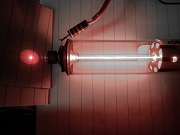
The source isn't powered in that picture. We would be having a bad day if it was. At that point I was only measuring the activation products. When the tool is on it is in several hundred gallons of water. Not a great environment for a NaI detector held together with vinyl tape. The 2.5+ hour half life gave me ample time to drain the water tank and remove the tool before running the spectrum. Here is a picture of another tool that is in the tank right now, firing neutrons. You can see that it is completely surrounded by water. The large block is pure aluminium. That allows testing of the spectroscopy system used by the tool.
You do not have the required permissions to view the files attached to this post.
Last edited by Geoff on 27 Oct 2017, 18:17, edited 1 time in total.
-
Sesselmann
- Posts: 1398
- Joined: 27 Apr 2015, 11:40
Re: Manganese 56
I see, so the manganese drill bit collar was in the watertank while it was being activated.
As a matter of interest, what is the neutron flux near the tank, and are you getting any xrays at all?
It looks like around 30-40 cm of water surrounding the source, is that right?
As I have been designing and building neutron sources I am interested in how this one works.
As a matter of interest, what is the neutron flux near the tank, and are you getting any xrays at all?
It looks like around 30-40 cm of water surrounding the source, is that right?
As I have been designing and building neutron sources I am interested in how this one works.
