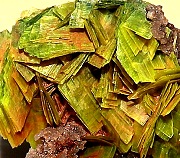
I received a small piece of curite - a uranium mineral - from a mineral collector. Many uranium minerals such as uranocircite or torbernite are green in color. Not so with this mineral. Bright orange-red ! A uranium-lead compound. Pb3[(UO2)4|O4|(OH)3]2 ·2H2O
Of course, there are no surprises with this spectrum, but there is a hint that it is a very powerful source.
Hello Massimo,
of course I saved the values.
The total measurement time was 4.37 hours. During this time it was 395.9 CPS in total. The background rate in my system is only 16.5 CPS. The net rate of the probe is 379.4 CPS. From a measurement with a Geiger counter and taking into account the distance, I measured an activity of approx. 40 - 50 kBq.
A good trick for quesstimating activity of radium containing materials is the dose rate.
At 2.5 cm distance a radium point source gives ~1 µSv/h per kBq. If you have a good geiger counter you can confirm your guesstimate that way!