
Hello to all,
(sorry for my aproximate English :-) !)
I am interested in your expertise for some peaks.
The spectrometer is made of a Na(Ti) crystal of 30x60 mm and a PMT Feu-85 in a rough lead shielding of 2,5 cm thickness and "GS-USB-PRO".
Below is the shielding.
I calibrated my spectrometer with Cesium 137 and Lutecium 176 at the same time
Below is the spectrum of the calibration:
Question 1: Is the peak at about 510 KeV positron annihilation OR sum peak 202+307?
With the same configuration I made the spectrum of a pitchblende sample from an old Uranium mine.
Its composition is known and without presence of Thorium.
Below is the spectrum of sample 543 of Rabejac.
Question 2: Is the peak 3 at about 617 KeV the peak of Bi214 at 609.32 ?
Still with the same configuration I made the spectrum of a pitchblende sample coming from an unreferenced outcrop in a granitic zone.
This one seems to contain Uranium and its descendants but of precise composition not known.
Below is the spectrum of sample 549 from Douch.
Question 3: Is peak 1 at about 460 KeV the peak of Ac228 at 463.07 ?
Question 4: What is the peak 2 at about 678 KeV ?
Below, here are the 2 spectra "543 Rabejac" and "549 Douch" at the same scale, without resolution compensation:
Question 5 : how to explain the difference in composition.
- peaks 1 & 2 present at Douch, absent at Rabejac ?
- peak 3 absent in Douch, present in Rabejac ?
Thank you for your opinion.
expertise for some peaks
-
Jacques
- Posts: 4
- Joined: 24 Sep 2021, 17:18
expertise for some peaks
You do not have the required permissions to view the files attached to this post.
-
kotarak
- Posts: 65
- Joined: 07 May 2020, 05:46
Re: expertise for some peaks
Yes - on the Lu-176 spectrum the peak should be a sum peak at 509keV.
You are not going to have an appreciable 511keV annihilation peak without seeing a high energy peak at above 1022 keV - usually the 511 keV peak is observed with K-40 spectrums where you have an emission at 1460 keV.
In your case most of what you are seeing is the sum peak as often disintegrations in Lu-176 occur simultaneously at both principal energies.
for a reference - here is my Lu-176 spectrum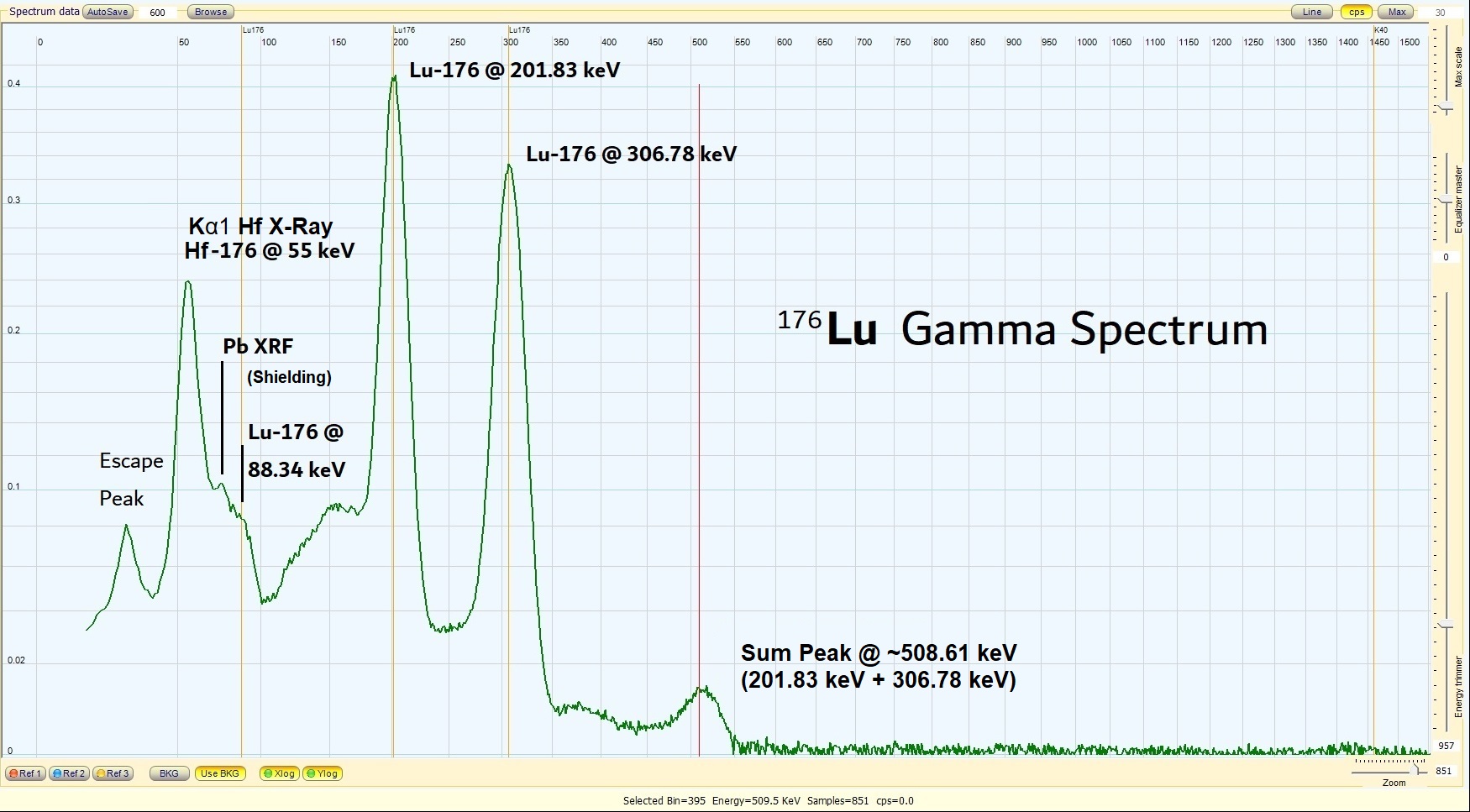
This is a plot over 20 hours - 9 hours for background subtraction and 11 hours Lu scan.
As for the Uranium spectrum it is difficult to say without knowing how linear is your detector - you did calibration up to 662 keV - it is a good idea to calibrate as well the higher energy region - you can use Co-60 or the K-40 peak for this. If the detector is not very linear due to wrong Bias voltage, it is possible that the lower energies check-out but then you get peaks above your highest calibration point shifted (or "compressed" or "stretched" ) by as much as a few hundred keV.
My normal calibration routine is done with Lu-176, Cs-137 and Co-60 while keeping an eye on the K-40 peak as well. Then I verify the calibration using Eu-152.
Keep in mind that with strong sources like most Cs-137 calibration sources, you'll also have a backscatter peak and a Compton edge which can be misidentified as stand-alone photopeaks
You are not going to have an appreciable 511keV annihilation peak without seeing a high energy peak at above 1022 keV - usually the 511 keV peak is observed with K-40 spectrums where you have an emission at 1460 keV.
In your case most of what you are seeing is the sum peak as often disintegrations in Lu-176 occur simultaneously at both principal energies.
for a reference - here is my Lu-176 spectrum
This is a plot over 20 hours - 9 hours for background subtraction and 11 hours Lu scan.
As for the Uranium spectrum it is difficult to say without knowing how linear is your detector - you did calibration up to 662 keV - it is a good idea to calibrate as well the higher energy region - you can use Co-60 or the K-40 peak for this. If the detector is not very linear due to wrong Bias voltage, it is possible that the lower energies check-out but then you get peaks above your highest calibration point shifted (or "compressed" or "stretched" ) by as much as a few hundred keV.
My normal calibration routine is done with Lu-176, Cs-137 and Co-60 while keeping an eye on the K-40 peak as well. Then I verify the calibration using Eu-152.
Keep in mind that with strong sources like most Cs-137 calibration sources, you'll also have a backscatter peak and a Compton edge which can be misidentified as stand-alone photopeaks
-
Jacques
- Posts: 4
- Joined: 24 Sep 2021, 17:18
Re: expertise for some peaks
Thank you kotarak for your attention and explanation.
I will try to find a source of K-40 (other than my 500g of KCl) at an "affordable price" to improve the calibration.
I will try to find a source of K-40 (other than my 500g of KCl) at an "affordable price" to improve the calibration.
-
kotarak
- Posts: 65
- Joined: 07 May 2020, 05:46
Re: expertise for some peaks
500g of KCL is plenty - just give it enough time - smaller size crystals are less efficient at higher energies so you'll have to make up with time - after a few hours you should get pretty good 1460 keV and 511keV peaks
