Building a LaBr3:Ce Gamma Spectrometer

Scintillation crystals, PMTs, voltage dividers etc...
User avatar
GigaBecquerel
Posts: 172
Joined: 04 Jul 2020, 07:34
Contact:

Building a LaBr3:Ce Gamma Spectrometer

Post by GigaBecquerel » 20 Aug 2020, 04:01

So far my gamma spectroscopy setup consists of a HPGe and a NaI(Tl) scintillation detector.
The first costs me almost 2€ per day to run, assuming I keep it cold all the time, the other one has a resolution of “only” 6.8% FWHM.

As everyone who’s been bitten by the radbug I am always hunting for better resolution, ideally without a constant supply of liquid nitrogen.
A good solution for this are novel high resolution scintillators based on lanthanide halogenides.
Lanthanum Bromide is one of the cheapest in that class, but it suffers from high ¹³⁸La Background, an alternative to that would be Cerium Bromide.
A mixture of Lanthanum Bromide and Chloride is sold as LBC by Scionix, and it appears to offer the best resolution over all.

Sadly most of those are out of the price range of a hobbyist, but Ost Photonics (https://www.ost-photonics.com/) is selling LaBr3:Ce for a price that’s almost affordable by hobbyists.

I could not resist and bought their smallest variant, a 10×20 mm crystal in its hermetic seal.
When I bought it I was quickly informed that it will be produced now and a few days later I got a shipping notification, and the information that the crystal was measured at 2.57%(!) with a Hamamatsu R6231-100.
The important part is the -100, indicating a Super-Bialkali Photocathode, with a higher quantum efficiency. This results in a higher resolution, and with regular Bialkali “only” 3.1 to 3.4% can be achieved.

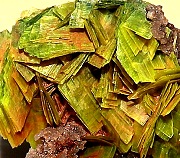
When the crystal arived it was packaged well, but the overall finish had a few things left to wish for. It was covered in epoxy, with some even on the window, and the Al case has some scratch marks.
photo_2020-08-18_22-51-19.jpg
photo_2020-08-18_22-51-19.jpg (51.15 KiB) Viewed 14280 times
photo_2020-08-18_22-51-20.jpg
photo_2020-08-18_22-51-20.jpg (60.76 KiB) Viewed 14280 times
photo_2020-08-18_22-51-17.jpg
photo_2020-08-18_22-51-17.jpg (60.94 KiB) Viewed 14280 times
To be fair, those issues are of a purely cosmetic nature and don’t impact the crystals performance.

I decided to use this crystal with a Hamamtsu R9420-20 Bialkali PMT, because it is my best known-good tube.
Dow Corning high vacuum grease was used as optical coupling gel, because of its high viscosity and because it has proven itself in many detectors I’ve built so far. After coupling I wrapped the remaining area of the photocathode with teflon tape to reflect any stray photons.
photo_2020-08-19_17-14-13.jpg
photo_2020-08-19_17-14-13.jpg (40.12 KiB) Viewed 14280 times
photo_2020-08-19_17-14-15.jpg
photo_2020-08-19_17-14-15.jpg (34.62 KiB) Viewed 14280 times
For the detector case I went with a proven method of aluminium endcaps on a stainless steel tube, as this provides both complete shielding and mechanical stability, as well as a low self absorption of gamma photons.
First I machined the endcap the detector would sit in, here it was important to make sure the walls were thin and the size was correct so the PMT would not sit with its photocathode right against it.
p1030834.jpg
p1030842.jpg
p1030837.jpg
Inside the cap the scintillator rests on a piece of sponge rubber, that gives a bit of mechanical padding but is basically invisible to gammas.
The outside wall of the endcap is 1 mm thick, the front surface has a thickness of 0.5 mm, giving me an absorption of about 50% at 19 keV, about 93% at 10 keV and ~5% at 30 keV.

I glued this endcap with black-colored epoxy to garantuee no light leaks, and after letting it cure over night I cleaned it up on the lathe.
p1030859.jpg
The other endcap housed connectors for high voltage and signal, namely SHV and BNC.
It is held in by three screws and made light-tight with an o-ring seal.
p1030856.jpg
p1030857.jpg
p1030865.jpg
And here we are, the mechanical part is finished!
p1030868.jpg
p1030867.jpg
I really like how it turned out, almost looks like a professional detector.
Maybe the stainless steel parts needs a bit of engraving with the basic data on it, but that’s outside of my abilities at the moment.

First tests were successful, and I reached an astonishing 3.2% FWHM @ 609 keV!
My goal going into this was to get <4% to make the investment over NaI(Tl) worth it, and I have well surpassed that. A high resolution spectrometer makes it possible to separate more peaks in a compex spectrum, aiding in nuclide identification, as well as allowing for a quicker “first glance”, as narrower peaks stand out faster.

Here is where we get to the downsides of this detector.
Due to the small size it has a very low detection efficiency and needs a long time to collect a spectrum, especially at energies above a few 100 keV. This is a simple fact of the size and can’t be changed by a different PMT or similar measures, only by a bigger crystal.
Lanthanum bromide also suffers of a ¹³⁸La background, introducing both gamma peaks and beta continua.
self-counting-background-spectrum-from-the-labr-3-ce-detector.png
self-counting-background-spectrum-from-the-labr-3-ce-detector.png (65.16 KiB) Viewed 14280 times
(intrinsic background of LaBr3:Ce
[broken link removed - Steven]

Because of the crystal size there’s low Lanthanum activity and the detection efficiency of its own gammas is not very high, so it only becomes visible after a long measurement. But then again, so do all higher energy gamma peaks.
The following two images are 10 hour background spectra, taken behind 5 cm of lead in every direction, the most dominant feature is the lead fluorescense, but one can see the bg spectrum shown above pretty well.
bkglin.png
bkglin.png (56.74 KiB) Viewed 14280 times
bkglog.png
bkglog.png (56.17 KiB) Viewed 14280 times
The following spectrum is of ²³²Th and its decay products, one can nicely see all the peaks of its decay chain. Most notably are the two ²²⁸Ac peaks at 911 and 969 keV respectively , which are hard to separate with NaI(Tl), but go down to the baseline with LaBr.
labr-th232-log-2.png
labr-th232-log-2.png (50.12 KiB) Viewed 14280 times
labr-th232-lin-2.png
labr-th232-lin-2.png (53.86 KiB) Viewed 14280 times
Compare this to the spectrum taken by NaI(Tl):
eakowjbxsaecov_.jpeg
eakowjbxsaecov_.jpeg (69.02 KiB) Viewed 14280 times
One interesting note is that LaBr is so bright that my 8 dynode PMT only needed a bias of ~500V to get a good spectrum, where others need almost twice that for NaI. This might pave the way for low power devices running at lower voltages, well in the range of where Geiger Müller counters usually are the standard.

Overall I am very happy how this detector turned out and I am sure that many more experiments will follow with it!
I’d love to see more hobbyists be motivated to spend the extra on high resolution spectrometers as they get more affordable. This detector was a total of about 500€ in materials cost, plus ~10 hours for manufacture and assembly of the housing.

I'd also want to thank Luuk, who has helped me a lot here and always pointed me in the right way, as there are many new things to learn with those high rez scintillators!

Best regards,
Lukas

(Copied from: https://gigabecquerel.wordpress.com/202 ... ctrometer/)

User avatar
iRad
Posts: 217
Joined: 01 May 2015, 12:27
Location: Stuart, FL USA
Contact:

Re: Building a LaBr3:Ce Gamma Spectrometer

Post by iRad » 20 Aug 2020, 05:07

Hi Lukas - Nice report on a very nice detector build. Surprising to see them send out such an expensive crystal in can that looks so bad, however it is only cosmetic as you mention. That Hamamatsu R9420 is really a very nice photomultiplier tube, proving itself in that you get 3.2% FWHM with just the standard version of the tube. Hopefully someday you can find the -100 version and replace it for a nice upgrade.
Last edited by iRad on 20 Aug 2020, 05:35, edited 1 time in total.
Cheers, Tom Hall / IRAD INC / Stuart, FL USA
Please check out my eBay Store: http://stores.ebay.com/The-Rad-Lab

luuk
Posts: 313
Joined: 01 May 2015, 21:00
Location: the Netherlands
Contact:

Re: Building a LaBr3:Ce Gamma Spectrometer

Post by luuk » 20 Aug 2020, 05:17

Hi Lukas,
Nice detector you build and a great report very nice.
I would be interested in the total background of your detector in cps/cc if you find time to measure that.
Have lots of fun with this new great toy.
Luuk

User avatar
GigaBecquerel
Posts: 172
Joined: 04 Jul 2020, 07:34
Contact:

Re: Building a LaBr3:Ce Gamma Spectrometer

Post by GigaBecquerel » 20 Aug 2020, 05:51

Thank you two for the kind words!

Luuk, what energy range is interesting for you here?
In my background spectrum I got 82366 counts in 37069 seconds, looking just right of the lead peak to a bit more than the 14XX keV gamma peak.
This is 2.2 cps, divided by the 3.14 cm³ of my detector I get 0.71 cps/cc.

Lukas

Edit:
I did a quick back of the envelope calculation and got an estimated total activity of ~5 Bq in this crystal, so I guess 2.2 cps is in the range of a reasonable efficiency.

kotarak
Posts: 65
Joined: 07 May 2020, 05:46
Location: Brookfield, CT, USA
Contact:

Re: Building a LaBr3:Ce Gamma Spectrometer

Post by kotarak » 21 Aug 2020, 09:06

Thank you for pointing to Ost Photonics! They have some inexpensive NaI(Tl) complete detectors and crystals as well as CsI(Tl) at pretty acceptable prices.
Granted, it is a Chinese company and as you saw first hand - they don't value much the finishing steps in the product manufacturing, but as long as it works as expected, that's all it matters. No CeBr3 crystals tho..:(
Andrey E. Stoev
Brookfield, Connecticut, USA

luuk
Posts: 313
Joined: 01 May 2015, 21:00
Location: the Netherlands
Contact:

Re: Building a LaBr3:Ce Gamma Spectrometer

Post by luuk » 21 Aug 2020, 14:52

Hi Lukas,
Thanks that is what I wanted to know 0.71cps/cc that is what was to be expected.
I was curious to see if they already found a way to improve the background, I know that Saint Gobain is
doing it's best to lower the background and improved the LaBr3 every time but only a little If I am right they have now < 0.4cps/cc. but
I am not sure have to look it up.
Thanks,
Luuk

User avatar
GigaBecquerel
Posts: 172
Joined: 04 Jul 2020, 07:34
Contact:

Re: Building a LaBr3:Ce Gamma Spectrometer

Post by GigaBecquerel » 21 Aug 2020, 17:09

Kotarak,
Yes, they have some very interesting scintillators for fairly cheap!
I am trying to resit buying one of everything, just to have them to play around with :D
A friend of mine ordered their 40x40 NaI a few days ago and I'll build him a detector with that, I am curious how the crystal turns out!
My LaBr is very good for its class, and it would be great if they managed to do the same with NaI, I'm hoping for sth. like 6.5%.

Luuk,
How do these "low" background LaBrs compare?
From what I gathered isotope separation is very expensive and I'm not sure if that's worth it for just about half the background, considering that there still are CeBr3 and SrI2 out there...

Lukas

User avatar
Peter-1
Posts: 170
Joined: 07 Oct 2016, 01:45
Location: Germany
Contact:

Re: Building a LaBr3:Ce Gamma Spectrometer

Post by Peter-1 » 21 Aug 2020, 19:36

Hello,
I am impressed how good the resolution is. But now I also wanted to check whether the two lines can be resolved with my NaI crystal. In order to suppress the area of ​​low energy, I placed a copper plate with a thickness of 21mm in front of the NaI crystal 2"x 2". I used ThF4 from Oerlikon-Balzers as a source. The measurement time was ~ 6 hours. The two lines of Ac228 at 911 and 969keV can be seen separately.
2020_08_20-ThF4-Cu-a.png
Peter

User avatar
GigaBecquerel
Posts: 172
Joined: 04 Jul 2020, 07:34
Contact:

Re: Building a LaBr3:Ce Gamma Spectrometer

Post by GigaBecquerel » 21 Aug 2020, 20:29

Hi Peter,

Maybe it was bad wording on my side, they can be separated with NaI, but they appear as one hump, as opposed to the down-to-baseline peaks of LaBr.
Here's a small comparasion, HPGe vs LaBr vs NaI:
Attachments
alle_lin.PNG
alle_lin.PNG (72.45 KiB) Viewed 14205 times
alle_log.PNG
alle_log.PNG (74.12 KiB) Viewed 14205 times

luuk
Posts: 313
Joined: 01 May 2015, 21:00
Location: the Netherlands
Contact:

Re: Building a LaBr3:Ce Gamma Spectrometer

Post by luuk » 22 Aug 2020, 04:37

Hi Lukas,
The crystal crowers are always looking to improve the crystals, and not just by using different growing methods but also searching for better base materials.
One way is to select other materials or from other suppliers e.g. some mines will give just a different base materials that can give a big impact on the final result, such as background or resolution, and/or changing the balance between the different basic materials just a little, it is often the “try and error” method and if lucky they find a crystal with the same excellent performances but just that little less background.
So that is the reason that the crystals from one supplier are just a little better than crystals from the other supplier.
Luuk

Post Reply

Who is online

Users browsing this forum: No registered users and 504 guests